AEDAS Homes and industrialised housing
What AEDAS Homes has reported about La Maquia and the 3,193 industrialised homes in its 2024-25 financial year.
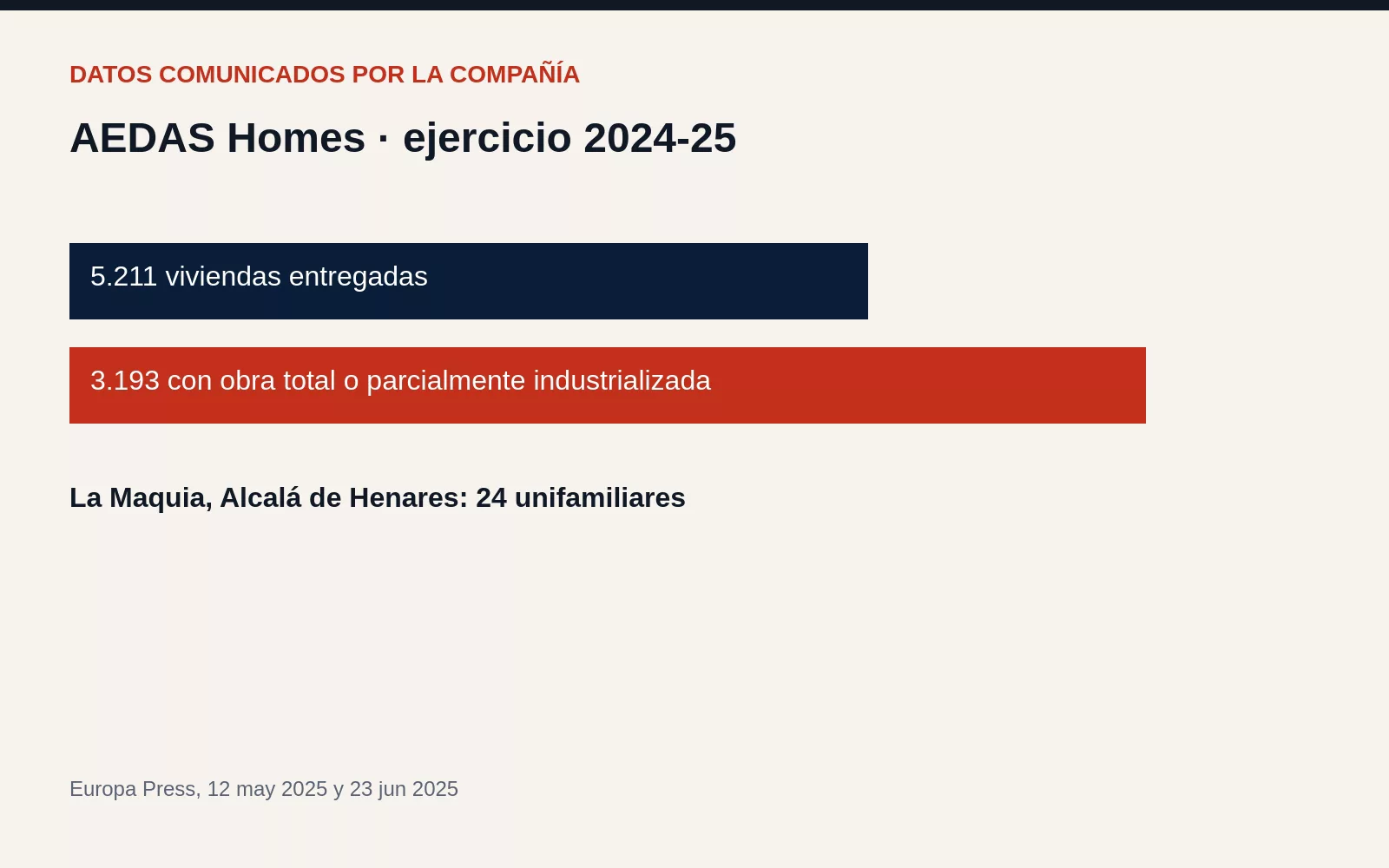
AEDAS Homes has spent years saying that a growing share of its homes is made, wholly or partly, away from the building plot. The figures in circulation do not come from a public census of industrialised buildings. They come from the developer. Europa Press published them in two 2025 stories drawn from company statements. This article treats them that way: company data, with a date and a link, not as an official industry statistic.
La Maquia, as the company that handed it over describes it
On 12 May 2025 Europa Press reported the handover of La Maquia, in Espartales Norte, Alcalá de Henares. The story, based on the company, describes 24 three-bedroom houses with gardens and a basement room of about 50 square metres lit by an English courtyard. AEDAS Homes presents it as its tenth fully industrialised scheme and as the first project of that kind in Alcalá de Henares. With it, the company says, it approaches 200 finished industrialised homes based on three-dimensional modules across the country.
The earlier schemes named in the release, and repeated by Europa Press, are Merian, Merian II, Merian Gardens, Etheria, Gaetana, Gaetana II, Gaetana III, Gaetana IV and Tinné. Marta Bueno, AEDAS Homes’ development manager for the central region and the person responsible for La Maquia, describes a commitment the company dates to 2018: a building system meant to shorten programmes, raise the quality of workmanship and reduce the impact of the site. She cites air-source heat pumps, heating and cooling floors, and thermal insulation. She also said the last homes were still for sale, ready to move into, from 495,000 euros. That is a sales price, not a valuation.
The same story places industrialised work in the developer’s wider book, again with company figures: more than 100 wholly or partly offsite projects and nearly 7,000 homes. From 2023, 25 per cent of the homes it delivers would be wholly or partly industrialised, and the company’s ESG plan for 2024-2026 would raise that commitment to 30 per cent from 2026. These are internal counts and targets. They show where the developer says it is going. They are not a public register.
The 2024-25 year, also from a statement
Six weeks later, on 23 June 2025, Europa Press published a second story. The headline — six in ten homes delivered are industrialised — summarises a statement. The news copy says that more than 60 per cent of the homes delivered in the 2024-25 financial year were built wholly or partly off site, using modern methods of construction. The breakdown the company gave, and which the paper transcribes, is specific: of 5,211 homes delivered, 3,193 were fully industrialised modular homes or included factory-made components such as bathrooms, structures, stair cores, flues or facades.
José María Quirós, AEDAS Homes’ head of industrialisation, says in that story that those homes — he rounds the figure to 3,200 — cover for-sale product, build to rent for third parties, and affordable housing. He adds that the 2,060 homes delivered under the Madrid region’s Plan VIVE I have industrialised bathrooms. He does not say those 2,060 homes are complete modules. He says they include a factory component. The difference matters. A scheme can count as “industrialised” in the statement because of a prefabricated bathroom, while another can be an entire three-dimensional module, like La Maquia. The 3,193 mixes the two, and the story says so: “100 per cent industrialised modular homes or included offsite components”.
In the same year the company highlights two jobs. In Alcalá de Henares, a 184-home rental scheme was, according to the statement, AEDAS Homes’ first project with a precast concrete structure and load-bearing facade; structure and facades were completed in six months. In Mallorca, Maremma, 26 houses, is presented as the company’s first Passivhaus scheme with a timber structure. Again: facts the developer is reporting, not a measurement made for this article.
Quirós dates the offsite line to 2018. Since then, he says, the company has finished, has under construction or has in design more than 12,500 homes in nearly 150 projects. The May figure (nearly 7,000 homes in more than 100 projects) and the June figure (more than 12,500 in nearly 150, including work not yet handed over) do not collide if the verb is read carefully. One is the offsite book as the company grouped it at one moment. The other widens the boundary to work still being designed. Both are the company’s. Neither is a national census.
The problem the company says it is solving
The June story quotes Quirós on the commercial case: supply has to be produced, especially affordable supply, and modern methods would be a faster lever; industrialisation, he adds, eases the shortage of site labour and gives more certainty on cost. That is an argument from someone who sells the system. It can be quoted without being adopted as a conclusion. What the two stories do show is the kind of piece the company is willing to take off the site: sometimes a bathroom, sometimes a structure and a facade, sometimes the whole house as a module.
La Maquia is the clearest end of that range. Twenty-four houses, a family product, a new neighbourhood in Alcalá, and a developer that counts them as delivered three-dimensional modules. The 2024-25 year shows the scale: thousands of handovers in one year, and a majority — on the company’s own account — with something made off site. For anyone comparing schemes, the useful question is not whether “AEDAS is industrialised”. It is which piece is industrialised in each case, and whether the repeated number counts only complete modules or also components. Europa Press, in the 23 June story, leaves that line in writing.