Spain’s housing shortage: why homes are missing, and what factory building can add
The Bank of Spain puts the cumulative housing shortfall from 2021 to 2025 at about 750,000 homes. What that figure measures.
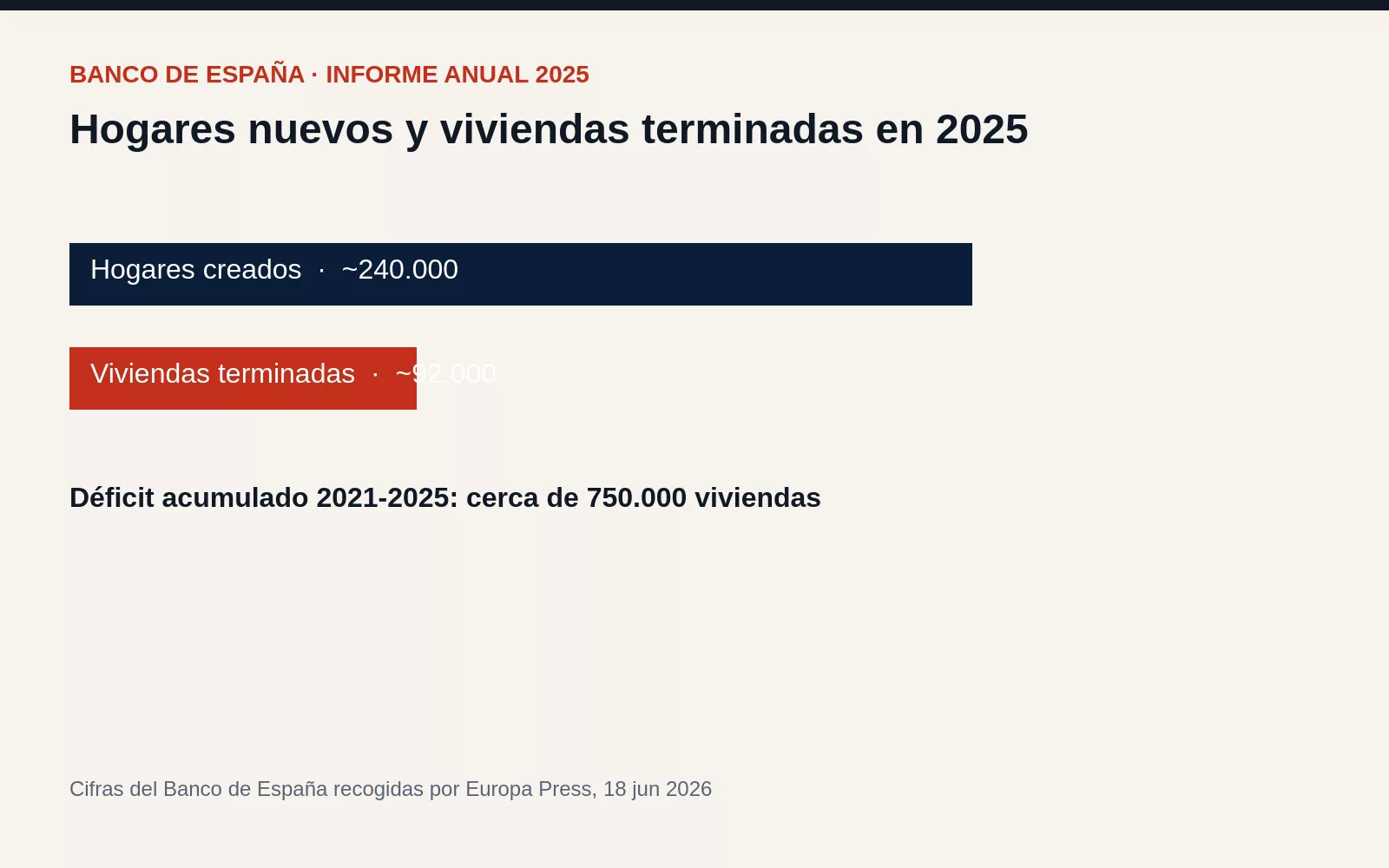
Homes are missing where people want to live, and the gap is not explained by one cause or closed by one kind of building. The Bank of Spain, in the housing chapter of its 2025 Annual Report, has put a number on the gap between new households and finished homes. Europa Press published it on 18 June 2026: a cumulative shortfall of about 750,000 homes between 2021 and 2025, because more households were formed than homes were built.
This piece does not add another calculation. It uses the Bank’s, in the version the paper transcribes, and it separates what that number measures from what it is sometimes asked to mean.
What the shortfall measures
It is not a list of people without a roof, and it is not a door-to-door census of unmet demand. It is the difference, over five years, between households being formed and homes being completed. Europa Press, citing the report, gives the last of those years: in 2025 about 240,000 new households were formed and about 92,000 homes were completed, 9 per cent fewer than the year before. One year’s gap is not 750,000. The running total from 2021 to 2025 is what approaches that figure, according to the Bank.
The same dispatch carries more of the report, all of it quantities rather than slogans. Home sales grew 12.1 per cent in 2024 and 5.1 per cent in 2025. In 2025 they passed 750,000 transactions, a volume the Bank compares with the twelve-month total in the first quarter of 2008. Those deals were 3.8 per cent of households, against an average of 5.5 per cent from 2004 to 2007. New mortgage lending for home purchase grew 27.5 per cent in 2025 and the number of mortgages 14 per cent. The Bank adds that lending standards remain stricter than in the previous boom and that it does not see the same macro-financial imbalance as before 2008.
The effort required to get a home, on those same figures, is not the same for everyone. The ratio of purchase price to net income is 4.3 years for households as a whole, 6.8 years for people who are not owners, 7.1 for young people and 7.6 for households of foreign origin. The share of households that own their main home is 73.3 per cent, and the share who rent is 20.2 per cent. Among people under 30, 54.7 per cent rent. The rate at which people up to 35 had left the parental home was 31.5 per cent in 2024, 13.5 points lower than in 2007.
Where it is concentrated
Europa Press does not split the shortfall by province in the 18 June story. Other papers, reporting the same chapter, did carry a split: more than half of the gap, 52.5 per cent, in Madrid, Barcelona, Alicante, Valencia, Murcia and Málaga. Because that sentence is not in the Europa Press dispatch used here as the main source, it is not presented as a quotation from that dispatch. What does come through the Bank’s own account, via those reports, is that the mismatch is uneven. It weighs more in large urban areas and on people with less income, particularly the young and people of foreign origin.
The governor’s presentation of the 2025 Annual Report, published by the Bank, does not repeat the figure of 750,000 in the summary pages. It describes the same picture: strong housing demand, rising prices, contained financial risks, and a rigid supply. The round number has to be taken from the reportage of the chapter, not from the slides.
Why supply does not keep up
The Bank, as Europa Press reports it, puts the access problem mainly down to limits on supply. Among the constraints on new building it cites scarce developable land, slow urban development and planning management that does not speed things up. Inside the industry it points to lower productivity, small firms, a shortage of labour and contained margins in construction and development. It also notes that purchases by non-residents and tourist use of homes take residential stock out of reach in parts of the coast, the islands and some city centres.
None of that is a government programme. It is a central bank’s account of why finishing homes is slower than the pace of new households. Demand-side measures, in the same account, can ease pressure in the short run and can, if they are badly designed, hold supply back later. This article does not choose between them. It stays with the quantity: fewer homes are finished than would be needed to keep up with the households being formed.
Where factory work fits
Industrialising construction does not fill 750,000 homes. No single project, however fast, is that large. What does change, when the bottleneck is time on site and labour on the plot, is how many homes a site can finish in a given programme.
The documented example at the other end of the map is Ten Degrees in Croydon: 546 rental homes, towers of 44 and 38 storeys, more than 1,500 modules and a 26-month programme published by the developer and by New London Architecture. It is not a pattern to copy onto a Spanish street. It is evidence that a large part of a building can arrive finished and be stacked when the plot cannot carry a long site. In Spain, the scale a large developer has put in writing is different. AEDAS Homes reported, and Europa Press published on 23 June 2025, that of 5,211 homes delivered in the 2024-25 financial year, 3,193 had full modular construction or some factory-made component. La Maquia, in Alcalá de Henares, is 24 houses the same company counts as a fully modular scheme. Those are company figures, not the national shortfall, and they should not be added to the 750,000 as if they closed the account.
They are useful for something else. They show two ways of taking work off the plot: almost the whole building, as in Croydon, or pieces — bathrooms, structure, facade — that a Spanish developer is already handing over in thousands of homes a year, on its own account. If the Bank is right that site labour is short and that new supply responds weakly to price, making components in a factory is not a slogan. It is a way of using factory time, which does not compete with the street for the same calendar.
The limit should be stated as clearly as the figure. About 92,000 homes completed in a year, against about 240,000 new households, is not balanced by one scheme or one technique. It is balanced, if it ever is, when many sites finish more homes than they finish today. Industrialisation is one of the levers the people doing the work are already measuring in programmes and in pieces. It is not, by itself, the shortfall closed.